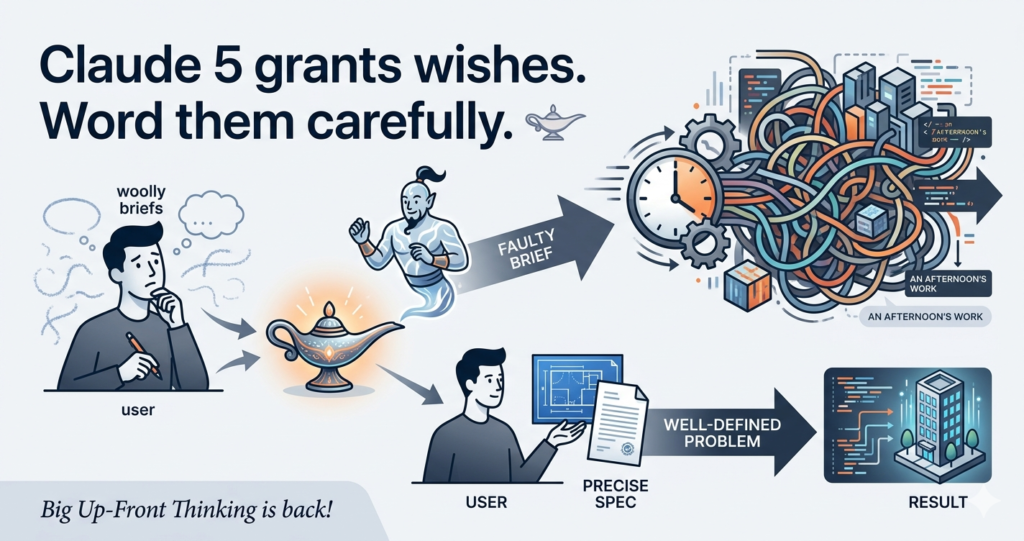
24 hours ago, I received an email from Anthropic announcing they had released Claude 5 (officially “Fable 5” – a Mythos-class model, apparently, which sounds like a ’90’s boy band ;-)). Within hours, my feeds were saturated with benchmark charts and breathless commentary, all circling the same question: how clever is it?
Allow me to suggest that this is the wrong question.
Cleverness is yesterday’s bottleneck
Buried in the launch material is the detail that actually matters: the longer and more complex the task, the larger this model’s lead over its predecessors. Fable 5 keeps going for hours. It doesn’t wander off and lose the plot – it stays focused on achieving the task at hand.
That changes the unit of work enormously. The previous generation of models are sprinters: brilliant over a single prompt, wheezing by the tenth. This one is a marathon runner – ready to push through when things get tough and break through the wall.
Relentlessly loop
The value is in the loop. Define an outcome, hand over the tools, and let the model plan, attempt, test, fail, and retry. A model that doesn’t degrade over long horizons is precisely a model built for loops. Single prompts are for consumption. Loops lead to the creation of something new. My best anything – be it writing, product creation or hair styling – is born out of iterating. Looping compounds the intelligence that was always there – in both machines and people.
Big Up-Front Thinking is back
Here’s the uncomfortable bit. When a model could only sustain one prompt, unclear requirements produce something that you didn’t intend. Annoying, but cheap – in terms of both money and time. When a model can run unsupervised all afternoon on a complex project, a woolly brief gets executed faithfully, at machine speed, for the entire afternoon. Now the output is only limited by the quality of the input. Now the thinking needs to be comprehensive, complete and documented up front, while the model iterates on figuring out the right solution! Small increments are heading for the museum – see my reframing of the Agile Manifesto.
I’ve written before about solution pollution – requirements muddled up with someone’s pet implementation. Claude 5 doesn’t cure that disease; it industrialises it. Tell it to “build the dashboard with the blue export button” and it will dutifully loop its way to a magnificent answer to the wrong exam question. The model is no longer the bottleneck. Your problem definition is. The machines are finally true genies, but the hard thinking is still ours.
Use sparingly
Should everything become a loop? No. For a quick fact or a tidied-up email, a single prompt remains the right tool, and looping it would be performative nonsense. But for challenging work – the really hard-to-solve, stirs you at 3AM kind – don’t ask yourself how clever Claude 5 is. Ask how clearly you can state the problem, then get out of its way.
Strong opinion, loosely held.